
How to design a passive radiator box
Ask AI about this page
A passive radiator gives you the bass extension of a ported box without the port: no chuffing, no long tube to fit inside a small box. Here's how to size one, step by step, with a real driver.
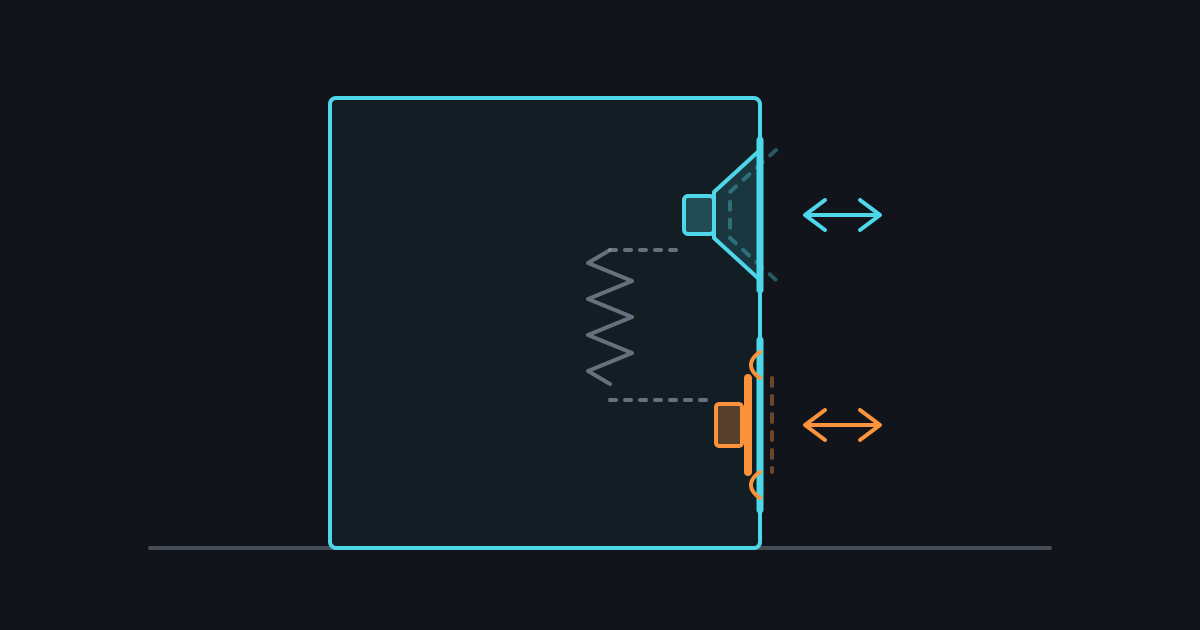
What a passive radiator does
A passive radiator (PR) is a speaker cone without a magnet or voice coil. Inside a sealed box, the air pushed by the woofer moves the PR, and the PR's mass bouncing on the springiness of the air in the box forms a resonance, just as the air in a port does. Tune that resonance (Fb) low and the box gives extra bass around it, like a ported box.
Why use one instead of a port?
- No port noise. A small port at high power makes air rush and "chuff". A PR has no moving air jet.
- Small boxes. A port tuned low in a small box can be longer than the box is deep. A PR only needs space on one face.
- No midrange leaking out of a port opening, and no port resonances.
What it costs:
- A notch below the tuning. At the PR's own resonance the woofer and PR cancel, so the response falls faster below Fb than a ported box's (and the excursion rises sharply below the notch, so use a high-pass filter).
- More cone area to move. The PR has to move a lot of air: as a rule it needs about twice the woofer's displacement (Sd × Xmax).
- Price and size. A good PR costs about as much as the woofer, and is often bigger.
The worked example
The rest of this guide uses a Dayton Audio DSA215-8, an 8″ woofer (Fs 35 Hz, Qts 0.33, Vas 37.4 L, Xmax 5.5 mm), at 35 W with a 30 Hz high-pass filter. All the numbers below come from Speaker Box Genius; open the example to see the charts and change anything.
Step 1: choose the box size and tuning
Start as if you were designing a ported box. A flat alignment is a good first try: for this driver, QB3 gives 18.0 L tuned to 41.7 Hz (the box WinISD's wizard gives too).
In the app, choose QB3 from the passive radiator design's Preset list: it sets the box volume, the target tuning and the added mass for your driver and PR in one go. You can go bigger for deeper bass or smaller to save space; the charts show what you trade.
Step 2: pick a passive radiator that can keep up
The PR has to move more air than the woofer, because near Fb most of the sound comes from the PR. Compare displacements, Sd × Xmax:
| Sd | Xmax | Displacement | |
|---|---|---|---|
| DSA215-8 woofer | 211 cm² | 5.5 mm | 116 cm³ |
| DS215-PR (one) | 211 cm² | 11 mm | 232 cm³ |
One DS215-PR has twice the woofer's displacement, which is about right. If a PR falls short, use two of them, or a bigger one if it fits on a face of the box.
Rather than checking every PR by hand, press the ✦ button beside the PR picker (Find a PR for this driver) in the passive radiator design. It tries every PR in the database (and, if you tick the box, woofers used as PRs) in groups of 1, 2 or 4, tunes each one to your target, and ranks them by bass extension and spare travel. For this box, three of the top results:
| PRs | Added mass | F3 | Travel used when the woofer reaches its Xmax |
|---|---|---|---|
| 1 × Dayton DSA270-PR (10″) | 79 g | 50.7 Hz | 47 % |
| 1 × Dayton DS215-PR (8″) | 4 g | 52.5 Hz | 74 % |
| 2 × SB Acoustics SB20PFC-00 (8″) | 48 g each | 50.4 Hz | 39 % |
The bigger the PR (or the more of them), the more travel it has to spare and the deeper the box goes, but the dearer it gets and the more room it takes on the box. The rest of this guide uses the single DS215-PR: the cheapest and smallest option that still keeps up.
Once the design has a PR from the database, the finder can also order the list by how alike each is to the one you use (Order → Closest to …: total cone area, travel, moving mass and Vas), with the one in use first, so you can see which others would do the same job if yours is out of stock. Driver pages list the next three PRs that work in their suggested PR box under it, each a link that opens the app with that PR in place.
Step 3: tune it with added mass
A PR's tuning depends on its moving mass and the box volume. Out of the box, one DS215-PR in 18 L tunes to about 42.8 Hz. Adding mass to the cone lowers the tuning: just 4 g brings it down to the 41.7 Hz target (in a smaller box, or for a lower tuning, it takes a lot more). Most PRs come with a threaded bolt for adding washers.
Keep the added mass reasonable. Past about 1.5 times the PR's own moving mass, the cone can sag and rock, and the finder flags it; past three times, it's ruled out. If the tuning needs more mass than that, use a PR with a heavier cone, or two PRs (two PRs in the same box need more mass each, because the box air is shared).
The app does the sums: type the target Fb in Tune to and press Set mass under it, or use the ✦ Best tuning button beside Fb for the added mass that gives the flattest response, the deepest bass or the smallest box.
| Enclosure | Peak |
|---|---|
| Ported | 0.5 dB@ 187 Hz |
| PR | 0.4 dB@ 216 Hz |
| Enclosure | Peak |
|---|---|
| Ported | 0.5 dB@ 187 Hz |
| PR | 0.4 dB@ 216 Hz |
Step 4: check the excursion at your real power
This is where PR designs fail. Look at both excursion charts at the power you'll actually use:
- Cone excursion against the woofer's Xmax (5.5 mm).
- PR excursion against the PR's Xmax (11 mm).
At 35 W with the 30 Hz high-pass filter, the woofer peaks at 5.3 mm and the PR at 7.9 mm. Both are within their limits.
The PR chart also shades a band from 75 % of the PR's Xmax up to it (8.25 mm here). A PR's suspension stiffens as it nears its limit, so its travel stops growing in step with the woofer's and its distortion rises; staying under the band leaves that headroom. 75 % is a rule of thumb, not a datasheet figure: change it, or turn it off, with PR caution in Settings → Limits → Port speed & excursion. This design's 7.9 mm is 72 %, under the band.
| Enclosure | Peak |
|---|---|
| PR | 7.9 mm@ 35.1 Hz |
| Enclosure | Peak |
|---|---|
| PR | 7.9 mm@ 35.1 Hz |
Without the high-pass filter, the same 35 W pushes the woofer to 12 mm (more than twice its Xmax) down at 15 Hz, where the PR no longer holds it back. A PR box almost always needs a high-pass filter (a "subsonic" filter) just below the tuning.
The Max SPL chart puts it together: the loudest the box can play at each frequency, and whether the woofer, the PR or the amplifier's power is the limit there. Switch it to Volts or Amps to see what the amplifier must deliver to get there.
The cone excursion chart's mm · % · cm³ · m/s · g · N switch (a menu on phones; both excursion charts follow it) shows the same motion as a share of each one's Xmax (%, so the woofer and the PR read on one scale), as the air each moves (cm³, Sd × excursion), or as velocity, acceleration or force: moving mass × acceleration, the push each cone or PR puts into the box (with the PR's added mass). Settings → Limits → Port speed & excursion → Excursion shows it as the peak one way (the default, as datasheets give Xmax), peak-to-peak or RMS. The PR's force peaks near the tuning, where it moves most: mount PRs on a stiff panel, or two facing opposite ways so their pushes cancel. The red marking and the dashed Xmax curve still show excursion, so the limits read the same in every unit.
Step 5: compare it with a port
It's worth putting a ported box of the same size next to the PR box, because the result often surprises people: the port goes a little deeper (F3 49.2 Hz against the PR box's 52.5 Hz). The catch is the port itself:
| Port diameter (plain tube) | Length for 41.7 Hz | Peak air speed at 35 W |
|---|---|---|
| 5 cm | 15 cm | 21.5 m/s: chuffs (over 17 m/s) |
| 6 cm | 23 cm | 14.9 m/s |
| 7 cm | 32 cm | 11.0 m/s |
An 18 L box is only about 26 cm deep. The 7 cm port doesn't fit without bending it round; the 6 cm port just squeezes in, leaving 3 cm behind its inner end where a port diameter is the usual advice; and the 5 cm port that fits easily chuffs. That's where the passive radiator earns its place: in a small box, at real power, it does the port's job without the noise. In the example, the ported box uses the 5 cm port; try 6 or 7 cm and watch the port speed fall and its length grow.
Checklist
- Start from a flat alignment (QB3) for your driver's box size and tuning.
- Pick PRs with about twice the woofer's displacement (Sd × Xmax), that fit on a face of the box.
- Tune with added mass, keeping it under about 1.5 times the PR's moving mass.
- Check the cone and PR excursion at your real power, with a high-pass filter.
- Compare with a ported box of the same size before you buy the PRs.