
Sealed, ported or passive radiator: which box for your driver?
Ask AI about this page
The same woofer can go in a small sealed box, a big ported box or a passive radiator box. Each one trades size, depth and output differently, and each one fails differently when you push it. This guide puts one popular 10″ sub in all three at its full rated power, on the same charts, so you can see the trade-offs instead of arguing about them.
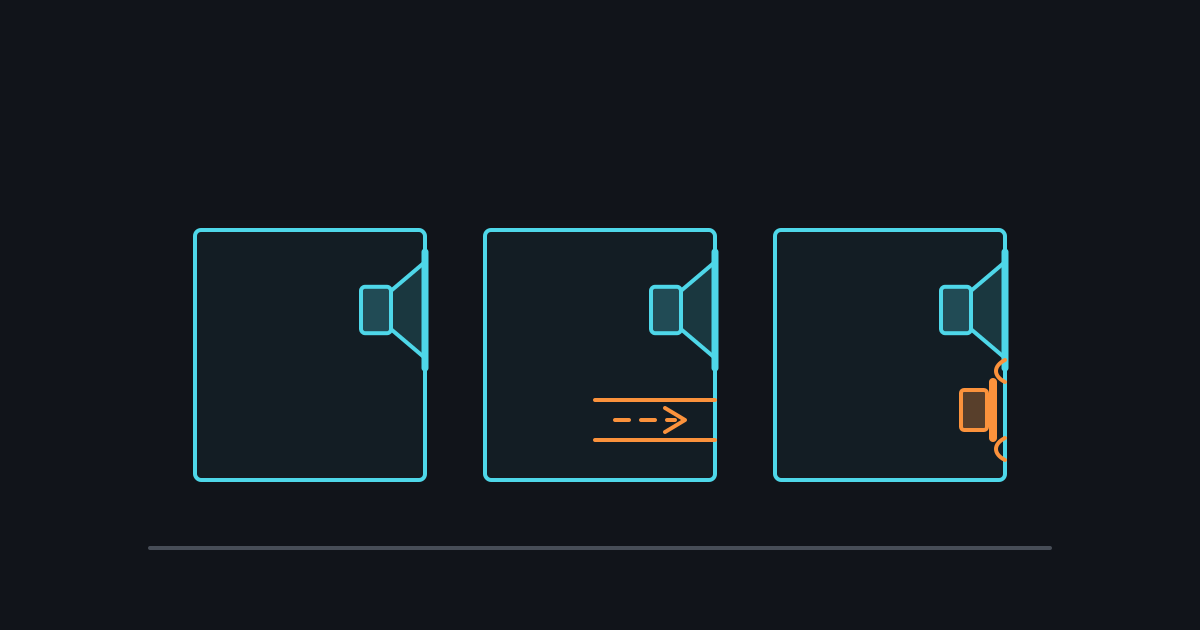
Open all three boxes (with a subsonic filter) → The same three, no filter →
Try it: the sealed box calculator sizes the sealed box for your driver, and the port length and passive radiator calculators finish the other two.
The short answer
- Sealed is the smallest box, ported plays loudest near its tuning. Here sealed is 39.8 L with F3 41.1 Hz; ported is 86.4 L with F3 21.1 Hz, and 12.2 dB more output at 25 Hz.
- The passive radiator box lands in between. Same box as ported, F3 23.2 Hz, 2.3 dB behind it at 25 Hz, and no port to fit. Below its tuning it falls away much faster.
- Above about 30 Hz the box type barely matters for output. All three run out of cone travel at about the same level at 40 Hz (within 3.2 dB), because the port only helps near the tuning.
- Every box needs a subsonic filter at full power. Without one the ported cone swings 43.5 mm at 10 Hz, more than three times its 12.3 mm Xmax. Even the sealed cone reaches 20.0 mm.
- Qts and EBP are a starting point, not a verdict. By EBP this driver "leans sealed", yet it's 12.2 dB louder at 25 Hz ported. Simulate both.
The setup
The driver is the Dayton Audio RSS265HF-4, a 10″ subwoofer [1]:
- Fs 25.6 Hz, Qts 0.45, Vas 54 L
- Xmax 12.3 mm, rated 350 W
It's driven at its full 350 W, behind a 24 dB/oct high-pass at 18 Hz. The boxes are the ones the app's presets give for this driver:
| Sealed | Ported | Passive radiators | |
|---|---|---|---|
| Preset | Qtc 0.707 | QB3 (flat) | the same box |
| Box | 39.8 L | 86.4 L, tuned to 22.3 Hz | 86.4 L, tuned to 22.8 Hz |
| Also needs | nothing | a 10 cm flared tube, 50.5 cm long | two RSS265-PR, two 75 g disks each |
Some practical notes:
- The sealed box is Qtc 0.707. The textbook formula, Vb = Vas ÷ ((0.707/Qts)² − 1), gives 37.3 L [2]; the app sizes it the way WinISD's wizard does, allowing for the 0.1 Ω of amplifier and cable and the box's own damping, which makes it 39.8 L.
- The ported box is the QB3 alignment, the flattest response for a driver with this Qts, sized the way WinISD's box wizard sizes it (the app gives the same box as WinISD to within 0.3 % [3]). The textbook lossless equations give a slightly smaller box (82.8 L for this driver, by Keele's curve fit); WinISD's allows for a box that leaks a little.
- The port keeps its air at 15.0 m/s at 350 W, under the 17 m/s chuffing line. But at 50.5 cm it won't fit straight in a cube-shaped 86.4 L box: use a taller box or one bend. Size all boxes picks a straight 7.5 cm tube that does fit, and tells you it chuffs at the driver's rating (port chuffing covers the trade).
- The passive radiators come with five 75 g disks each [4]. The PR preset asks for 164 g each, a little over two disks. Two disks (150 g) tune the box to 22.8 Hz, three (225 g) to 20.7 Hz.
Depth: an octave between them
| Enclosure | Peak |
|---|---|
| Sealed | 0.4 dB@ 123 Hz |
| Ported | 0.5 dB@ 100 Hz |
| PR | 0.3 dB@ 125 Hz |
| Enclosure | Peak |
|---|---|
| Sealed | 0.4 dB@ 123 Hz |
| Ported | 0.5 dB@ 100 Hz |
| PR | 0.3 dB@ 125 Hz |
Look at where each curve crosses the −3 dB line. The ported box (orange) holds flat to 21.1 Hz, a full octave below the sealed box's 41.1 Hz (blue). The PR box (green) gets most of the way, to 23.2 Hz, then drops off a cliff: by 15 Hz it's far below the other two.
That cliff is the passive radiator's own resonance. A PR is a port with a spring attached. With 150 g added it resonates at 19.6 × √(200 ÷ 350) = 14.8 Hz, and at that frequency it cancels the woofer's output, putting a notch in the response [5][6]. A port has no spring, so it has no notch.
A sealed box rolls off at 12 dB per octave, the ported and PR boxes at 24 dB or more [2][5]. That's why the sealed curve, starting an octave higher, is still above the PR's below about 19 Hz.
Output: where each box runs out
Response curves don't say how loud each box can go. The app's Max SPL chart does: at each frequency it finds the first limit hit (cone travel, port speed, or the 350 W rating) and colours the band underneath to say which one.
| Enclosure | Peak |
|---|---|
| Sealed | 110.0 dB@ 123 Hz |
| Ported | 110.1 dB@ 100 Hz |
| PR | 109.9 dB@ 125 Hz |
| Enclosure | Peak |
|---|---|
| Sealed | 110.0 dB@ 123 Hz |
| Ported | 110.1 dB@ 100 Hz |
| PR | 109.9 dB@ 125 Hz |
| Max SPL | 20 Hz | 25 Hz | 30 Hz | 40 Hz |
|---|---|---|---|---|
| Sealed | 93.2 dB | 97.2 dB | 100.4 dB | 105.4 dB |
| Ported | 104.6 dB | 109.4 dB | 107.3 dB | 108.6 dB |
| Passive radiators | 96.1 dB | 107.1 dB | 105.3 dB | 107.6 dB |
Three things to notice in that chart:
- At 25 Hz the ported box is 12.2 dB ahead of sealed. Near the tuning the port does the work and the cone barely moves (6.3 mm at 22.5 Hz, against 17.0 mm for the sealed cone at 25 Hz). The ported box takes its full 350 W at 25 Hz; the sealed cone hits Xmax at 183 W.
- At 40 Hz the gap shrinks to 3.2 dB. Above the tuning the port stops helping and every cone is back to its own travel. All three hit Xmax at about 276–284 W there. Look at the red bands: from 30 to 45 Hz all three boxes are excursion-limited.
- Below 15.6 Hz the sealed box out-plays the ported one (and below 19.2 Hz the PR box). Below tuning a ported or PR box stops loading the cone, which is the next section.
The amplifier each box needs for its 25 Hz maximum is different too:
- Sealed: 24.5 V and 3.6 A.
- Ported: 35.0 V and 6.7 A (its full 350 W).
- PR: 32.2 V and 5.4 A.
Switch the chart to Volts or Amps to see the whole curve; matching an amplifier explains reading it.
Cone travel: why every box needs a subsonic filter
| Enclosure | Peak |
|---|---|
| Sealed | 20.0 mm@ 10.0 Hz |
| Ported | 43.5 mm@ 10.0 Hz |
| PR | 35.6 mm@ 10.0 Hz |
| Enclosure | Peak |
|---|---|
| Sealed | 17.0 mm@ 25.0 Hz |
| Ported | 18.4 mm@ 17.3 Hz |
| PR | 19.8 mm@ 18.5 Hz |
Look at the left panel first, below 20 Hz. With no filter:
- The ported cone (orange) shoots to 43.5 mm at 10 Hz, more than three times its 12.3 mm Xmax. Below its tuning the port no longer holds the cone back, so it flaps against nothing [7].
- The PR cone (green) reaches 35.6 mm. It's a little better controlled, because the radiators' mass and suspension still load it [6].
- The sealed cone (blue) peaks at 20.0 mm. The trapped air keeps acting as a spring, so the sealed box is the gentlest, but at 350 W it's still well over Xmax.
Now the right panel, with an 18 Hz, 24 dB/oct high-pass:
- Ported: 18.4 mm at 17 Hz.
- PR: 19.8 mm at 18 Hz.
- Sealed: 17.0 mm at 25 Hz.
That's a big improvement, but none of them is under Xmax. At 350 W this driver is excursion-limited almost everywhere from 15 to 45 Hz, in every box. The filter stops the ported cone flapping below tuning; it doesn't give the driver more travel. You get the rest back by running less power (the Max SPL chart says how much at each frequency) or a filter set higher (subsonic filters works through that).
The passive radiators move too: 21.5 mm at 22 Hz with the filter, 24.2 mm without, just past their 24 mm Xmax. Check PR excursion whenever you push a PR box.
What the driver's parameters suggest
Two numbers from the datasheet point the way before you simulate:
- Qts, the driver's total Q. A Qts above about 0.6 has no flat vented alignment, so it suits sealed. Below about 0.4 it suits ported: the sealed box it needs for a flat response is large [2][8].
- EBP, the efficiency bandwidth product, Fs ÷ Qes. Under about 50 leans sealed, over about 100 leans ported, and in between it can go either way. That's the rule from Dickason's Loudspeaker Design Cookbook, building on Small's work [9].
| Driver | Qts | EBP | What the app says |
|---|---|---|---|
| Dayton Audio RSS210HF-4 (8″) | 0.57 | 43 | leans sealed, ported can work too |
| Dayton Audio RSS265HF-4 (10″) | 0.45 | 48 | leans sealed, ported can work too |
| Dayton Audio DSA215-8 (8″) | 0.33 | 88 | leans ported, sealed can work too |
Our 10″ is the interesting one. EBP 48 says sealed, but Qts 0.45 is comfortable in a ported box, and the ported box is 12.2 dB louder at 25 Hz. The rules are a filter for a shortlist, not a decision. Neither knows how much room you have or how deep you want to go. (Efficiency, depth and size trade against each other whatever the box: see Hofmann's Iron Law.)
How to choose
- Short of space? Sealed: 39.8 L instead of 86.4. It also suits a car, where cabin gain lifts the bottom end, and EQ like a Linkwitz Transform, because there's no tuning below which it unloads.
- Want the most output for your watts below 30 Hz? Ported, if the box and the port fit. Size the port for your power, and use a subsonic filter.
- Ported is right, but the port won't fit or would chuff? Passive radiators. You pay for them in money (two radiators) and a few hertz of extension, and get no port noise and no long tube.
- Want tight, well-damped bass? Sealed at a Qtc of 0.5–0.7 (sealed Qtc), or ported tuned low.
The forum claims, checked
| Claim | Verdict |
|---|---|
| "Ported is louder" | Near the tuning, by a lot: 12.2 dB at 25 Hz here. At 40 Hz only 3.2 dB, and below 15.6 Hz sealed wins. |
| "Sealed is tighter / ported is slow" | Mostly a myth. At 40 Hz the group delay is 11.0 ms sealed and 11.8 ms ported with the filter: 0.8 ms apart. At 25 Hz ported is 17 ms behind, which the group delay guide shows is below what listening tests find audible. |
| "A PR is just a port without the noise" | In the passband, yes. Below tuning it has a notch at its own resonance (14.8 Hz) and falls away faster: 8.5 dB less maximum output than the port at 20 Hz [5][6]. |
| "PRs protect the woofer better than a port" | A little: 35.6 mm against 43.5 mm with no filter. Still three times Xmax, so it still needs a filter [6]. |
| "Sealed subs don't need a subsonic filter" | They do at full power: 20.0 mm without, 17.0 mm with, against 12.3 mm Xmax. |
| "EBP tells you which box to build" | It narrows it down. This driver's EBP 48 says sealed; it works very well ported. |
Doing it in the app
- Driver: pick yours from the database or type in its parameters. Under the parameters (Edit T/S), a box hint shows its EBP, its Qts and which box they point to.
- Boxes: add a sealed, a ported and a passive radiator design, or press Size all. Each card's Preset choice resizes it: Qtc 0.707 on sealed; QB3 on ported and PR; all sized as WinISD sizes them. The other families that suit the driver (C4 and BB4 for this one) are in the same list, each with its box, a line on what it does and a small response curve. (Settings → Simulation → Box → Box presets → Textbook switches to the lossless textbook alignments.)
- Power slider: set it to what you'll use (Rated jumps to the driver's rating), and turn on Signal → High-pass.
- Charts:
- Response: depth (F3).
- Cone excursion: against the red Xmax line.
- Max SPL: the colour bands show what limits each frequency. Switch to Volts or Amps for the amplifier each box needs.
- PR excursion and Port speed: the radiators and the port.
For more on each box type, see the passive radiator guide and the port guide.
Try it: the ported box calculator gives a driver's QB3, C4 and BB4 boxes with a port that fits, without opening the simulator.
Sources
- Dayton Audio, RSS265HF-4 10″ Reference HF Subwoofer: Fs 25.6 Hz, Qes 0.53, Qms 3.06, Vas 54 L, Xmax 12.3 mm, 350 W (used with Dayton Audio's permission).
- R. H. Small, "Closed-Box Loudspeaker Systems, Part I: Analysis", J. Audio Eng. Soc. 20 (10), 1972: Qtc = Qts·√(1 + Vas/Vb) and the sealed box's 12 dB/octave roll-off.
- Speaker Box Genius, Validation: ported presets: the app's QB3, BB4 and C4 boxes next to WinISD 0.7.0.950's for 19 drivers. For the textbook (lossless) version, see diyAudio, the Keele vented-box formulas: Vb = 15·Qts^2.87·Vas, Fb = 0.42·Fs·Qts^−0.9.
- Dayton Audio, RSS265-PR 10″ passive radiator: Mms 200 g, Xmax 24 mm; supplied with five 75 g disk weights for tuning.
- R. H. Small, "Passive-Radiator Loudspeaker Systems, Part 1: Analysis", J. Audio Eng. Soc. 22 (8), 592–601, 1974, and "Part 2: Synthesis", 22 (9), 683–689, 1974; summarised in Passive radiator (speaker): the notch at the PR's resonance and the steeper roll-off.
- Parts Express, What is a passive radiator?: steeper roll-off below F3; PR systems unload below tuning like ports but control excursion a little better.
- A. N. Thiele, "Loudspeakers in Vented Boxes", J. Audio Eng. Soc. 19 (5/6), 1971: the vented-box alignments (QB3, B4, C4) and the cone's unloading below the box's tuning.
- diyAudio, Bass reflex alignments: Thiele's QB3 alignments for Qts under 0.383, B4 at 0.383, C4 above.
- diyAudio, EBP and Dickason's Loudspeaker Design Cookbook: EBP = Fs/Qes, under 50 sealed, over 100 vented, 50–100 either (LDC section 1.40, after R. Small).